1. How do you select plants for industrial and biotechnology campuses?
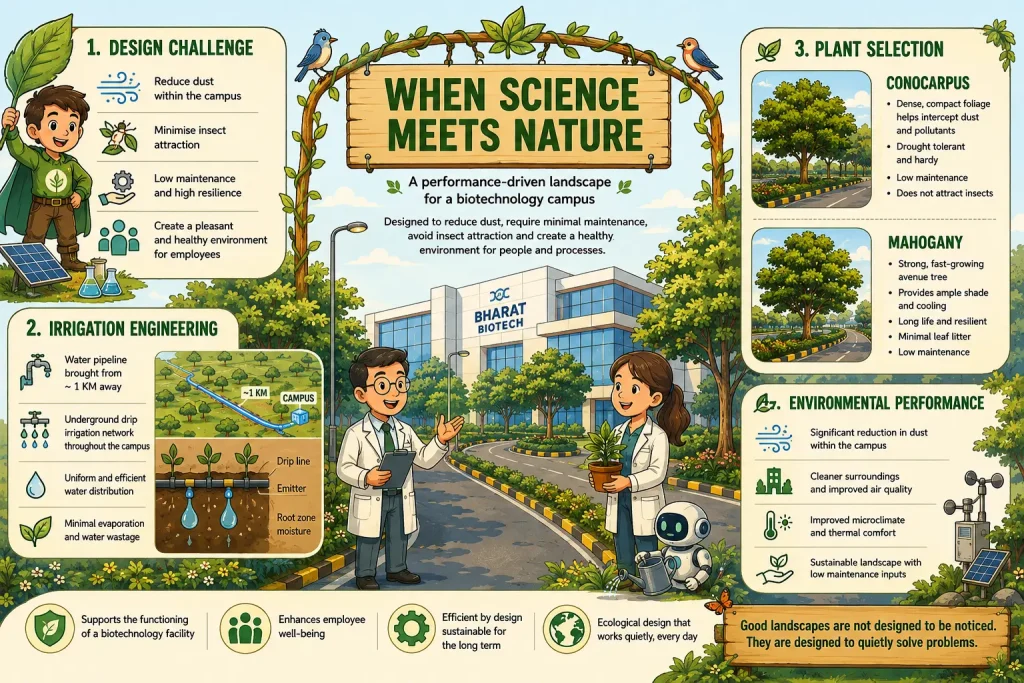
Plant selection should be based on function rather than appearance. Factors such as dust control, maintenance requirements, root behaviour, local climate and insect attraction are far more important than colourful flowers. Every campus has different operational needs that should guide the landscape design.
2. Why were Conocarpus and Mahogany selected?
These species were chosen because they are hardy, require relatively low maintenance and help reduce dust while being suitable for institutional environments. Plant selection should always respond to the purpose of the site rather than follow landscaping trends.
3. Can landscapes reduce dust pollution?
Yes. Trees and shrubs act as natural filters by trapping airborne dust on their leaves and reducing the movement of loose particles across open spaces. Properly designed green buffers can significantly improve the micro-environment around buildings.
4. How can landscapes help minimise insect problems?
Not all plants attract insects equally. For sensitive environments such as biotechnology campuses, plant species are selected carefully to avoid excessive flowering or fruiting that may attract insects. Maintenance practices also play an important role in controlling pest habitats.
5. Why is irrigation part of landscape design?
A landscape performs only when it receives the right amount of water. An efficient irrigation system reduces water wastage, improves plant health and lowers long-term maintenance costs. It is as important as choosing the right plants.
6. Are institutional landscapes different from residential gardens?
Absolutely. Residential gardens focus on lifestyle and recreation, while institutional landscapes prioritise functionality, safety, ease of maintenance and environmental performance. Every project should reflect how the space will actually be used.
7. What did this project teach CHAAS?
This project reinforced an important principle: every landscape should solve a problem. Whether reducing dust, supporting biodiversity or improving comfort, successful landscapes quietly contribute to the everyday functioning of the place they serve.